
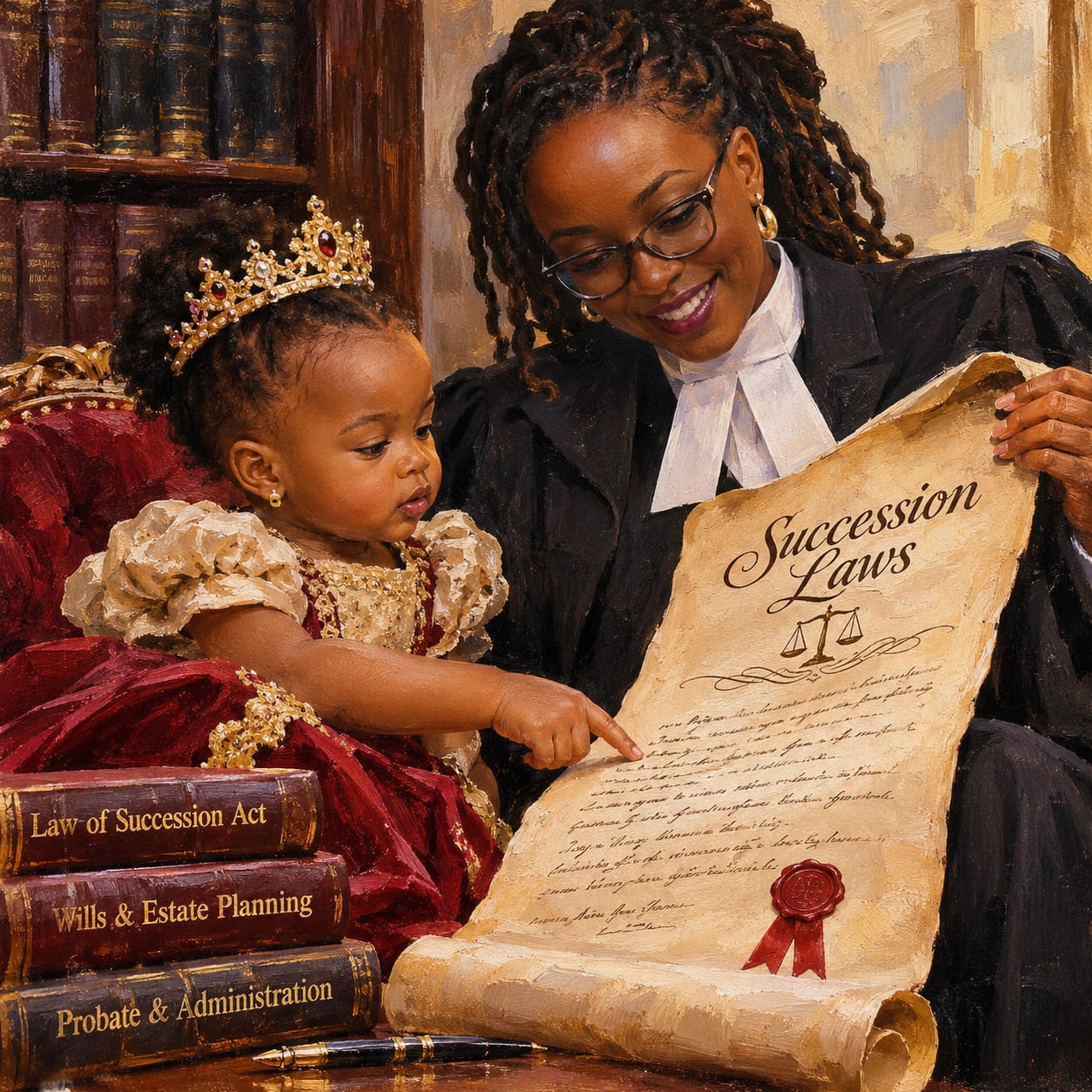
On 2 May 2015, a little girl was born in London. Her name was Princess Charlotte Elizabeth Diana.
At the time, she entered a royal family whose rules of succession had, for centuries, favoured sons over daughters. Under the old system of male-preference primogeniture, a younger son could leapfrog an older sister simply because he was male.
But something had changed. The United Kingdom had enacted the Succession to the Crown Act 2013, abolishing male preference in the line of succession for those born after 28 October 2011.
When Prince Louis was born in 2018, he did not overtake his older sister. Charlotte retained her position in the line of succession.
She did not have to prove that she was as capable as her brother. She did not have to negotiate with family elders. She did not have to take her brothers to court. The law had already recognised that being female did not make her less entitled to her place.
It was not a favour. It was a correction.
And while Britain was correcting the rules governing its royal family, Kenya had an equally important conversation to have about the rights of ordinary daughters to inherit their parents’ property.
From Buckingham Palace to Eldoret
Kenya has no monarchy, but for generations, many families have operated under inheritance practices that bear an uncomfortable resemblance to the old British system.
In some communities, land traditionally passed through the male line. Sons were considered custodians of family land, family names and ancestral property. Daughters were expected to marry and establish homes elsewhere.
The result? A father could spend a lifetime acquiring ten acres of land, distribute the property among his three sons and leave his two daughters with the explanation that their inheritance was their education, wedding expenses or the property of their husbands.
The familiar reasoning is that daughters will marry and leave, while sons will remain to continue the family lineage. It is a deeply rooted social expectation. But is it the law?
Absolutely not. Kenya’s succession framework has moved decisively towards equality of children, regardless of gender or marital status. The problem is that some family practices have not moved at the same pace.
The Law of Succession Act: a child is a child
The Law of Succession Act, Cap. 160, was enacted to provide a comprehensive framework governing the transmission and administration of deceased persons’ estates. It regulates both testamentary succession (where a person leaves a valid will) and intestate succession (where a person dies without a valid will).
One of its most important features is its gender-neutral approach to inheritance. Section 38 provides that where a deceased person leaves children but no surviving spouse, the net intestate estate is to be divided equally among the surviving children, subject to the relevant statutory provisions.
Notice what the law does not say. It does not distinguish between:
- Sons and daughters.
- Married and unmarried daughters.
- Children who remained in the family home and those who established homes elsewhere.
- Children who live in the village and those who live in Nairobi, Eldoret or abroad.
Section 35 provides for the rights of a surviving spouse where the deceased leaves a spouse and children, while section 40 provides the framework for distribution where the deceased was married under a system permitting polygamy. The statutory framework recognises the interests of the surviving spouse and the children of the deceased. It does not create a superior class of male children.
A married daughter does not lose her inheritance merely because she has married. A daughter who lives with her husband does not cease to be her father’s daughter. And a son does not acquire a superior claim simply because he remained on the ancestral land.
Marriage is not a disqualification from inheritance. Gender is not a qualification for inheritance.
There is, however, an important distinction: testamentary succession allows a person considerable freedom to distribute their property through a valid will, subject to the court’s powers to make reasonable provision for dependants under sections 26–29 of the Act. Equal distribution under intestacy should not be confused with an automatic entitlement to identical gifts under every will.
The Constitution comes before discriminatory custom
The Constitution of Kenya, 2010, fundamentally strengthened the legal protection of women’s inheritance and property rights. Three constitutional provisions are particularly important.
Supremacy of the Constitution
Any law, including customary law, that is inconsistent with the Constitution is void to the extent of the inconsistency. Customary practices are not beyond constitutional scrutiny simply because they have been observed for generations.
Equality and freedom from discrimination
Article 27 guarantees equality before the law and equal protection and benefit of the law. It expressly prohibits discrimination on grounds including sex, marital status and culture. A customary practice that excludes daughters from inheritance simply because they are female cannot claim constitutional protection.
Elimination of gender discrimination in land matters
The Constitution requires the elimination of gender discrimination in law, customs and practices related to land and property in land. This is particularly significant in rural communities, where land remains a major source of family wealth, economic security and social identity.
Read together, these provisions establish a clear principle: cultural practices must operate within the Constitution, not outside it.
It is also important to recognise that the Law of Succession Act contains specific statutory exceptions. Sections 32 and 33 address certain categories of agricultural land, crops and livestock in specified areas, where customary law may govern intestate succession. Muslim succession is also treated separately under section 2(3).
These exceptions do not create a general licence to disinherit daughters. Their application must be determined by the relevant statutory provisions and the circumstances of the estate.
The courts have been speaking
One of the most compelling illustrations of this legal evolution comes from right here in Eldoret.
Mary Rono v Jane Rono & Another
[2005] KECA 326 (KLR), Court of Appeal
The Court of Appeal considered a succession dispute involving the estate of Stephen Rono Rongoeicherono, a farmer from Uasin Gishu. The deceased had left two wives and nine children: six daughters and three sons. The dispute concerned, among other things, the distribution of the deceased’s estate and whether daughters could be disadvantaged because of their gender and marital circumstances.
The case became an important authority in the development of gender equality in succession matters. The Court considered the Law of Succession Act alongside constitutional principles and international human rights obligations, including the Convention on the Elimination of All Forms of Discrimination Against Women (CEDAW).
It challenged the assumption that daughters should receive less simply because they were women or were expected to marry. This was not an abstract debate about equality in a foreign royal household. It was a real family dispute involving land, property, siblings and competing claims to inheritance in Uasin Gishu.
Nyidha v Nyidha & Another
[2024] KEHC 8314 (KLR), High Court
Nearly two decades later, the High Court reiterated that section 38 does not distinguish between male and female children and that marriage is not a basis for excluding a daughter from her deceased parent’s intestate estate.
The courts have consistently reinforced the principle that inheritance rights cannot be defeated by discriminatory customary practices. The message is straightforward: a daughter is an heir too.
The gap between the law and family reality
Here is where the real challenge begins. The law may recognise a daughter’s right to inherit, but what happens when her father dies without leaving a will? A familiar sequence may follow.
The sons approach the local administration to obtain documentation relating to the deceased’s family and property. A family meeting is convened. The proposed distribution is discussed, sometimes with the assumption that the sons should receive the land. The daughters are informed that they have no claim because they are married. The estate is eventually distributed, or attempts are made to transfer or dispose of property, without properly involving all beneficiaries.
The daughter is left with a difficult choice: accept the exclusion or challenge her own family through legal proceedings.
For many women, the emotional and financial cost of challenging their siblings is considerable. Some remain silent because they do not wish to be branded as greedy, disrespectful or responsible for dividing the family. Others are simply unaware of their legal rights.
This is where succession planning and legal awareness become particularly important. A right that exists in legislation but is unknown to its beneficiary is a right that can easily be undermined in practice.
What happens when a family ignores the law?
Succession is not simply a family meeting followed by the subdivision of land. There is a legally prescribed process for administering a deceased person’s estate. Under section 45 of the Law of Succession Act, intermeddling with the free property of a deceased person is prohibited, except as authorised by law.
The administration of an estate ordinarily involves:
- Identifying the deceased’s assets and liabilities.
- Identifying all surviving beneficiaries and dependants.
- Applying for the appropriate grant of representation.
- Obtaining confirmation of the grant before distributing the estate.
- Ensuring that the proposed distribution complies with the law and the rights of beneficiaries.
An administrator does not acquire the deceased’s property personally by virtue of being appointed. Nor does being the eldest son automatically confer authority to distribute the estate.
Attempts to conceal beneficiaries, obtain grants through misrepresentation or distribute property without following the prescribed process may expose the parties involved to serious legal consequences. Where a beneficiary has been excluded, the law provides mechanisms for challenging grants, seeking revocation or annulment where the statutory grounds are met, and pursuing appropriate remedies.
The law does not require daughters to surrender their inheritance to preserve family peace.
Why succession planning matters
Do not leave your children to fight over your legacy.
There is an important lesson here for parents, particularly those who have spent decades building family wealth. You have worked hard to acquire land, invest in businesses, build rental properties, accumulate savings and provide for your children. But have you considered what happens to that wealth when you are no longer around to explain your intentions?
Dying without a will does not mean your property becomes ownerless. The Law of Succession Act provides a framework for distributing the estate. However, intestate succession can create uncertainty, disagreements and costly family disputes, particularly where there are multiple households, blended families, dependants or competing claims.
A properly prepared estate plan can help to:
- Clearly identify the assets forming part of your estate.
- Specify your intended beneficiaries.
- Appoint appropriate executors.
- Make provision for minor children and dependants.
- Address the interests of surviving spouses.
- Reduce uncertainty surrounding family businesses and jointly held property.
- Establish appropriate structures for preserving wealth across generations.
A will is not merely a document for the wealthy. It is an important estate-planning instrument for anyone who wants to provide clarity about the distribution of their property. Where appropriate, trusts and other estate-planning arrangements may also assist in protecting and managing family wealth, particularly where minor beneficiaries or long-term succession objectives are involved.
The objective is not simply to distribute property after death. It is to preserve family wealth and reduce the likelihood of avoidable disputes.
A girl in Eldoret should not have to be a princess to inherit
Princess Charlotte’s story is a useful reminder that even institutions with centuries of tradition can change discriminatory rules. Kenya has its own constitutional and statutory framework. We do not need to borrow British succession law to recognise the rights of Kenyan daughters. We already have the law. What we need is greater awareness, consistent application and a willingness to challenge practices that undermine those rights.
- A father in Eldoret should be able to make a will knowing that his intentions can be legally documented.
- A daughter in Moiben should know that marriage does not erase her identity as a child of her parents.
- A son in Marakwet should understand that respecting his sisters’ inheritance rights does not diminish his own.
- A family in Nairobi should not have to spend years in succession litigation because nobody thought to prepare an estate plan.
Charlotte kept her place because the law changed. The real milestone for Kenya will be when a girl born in Eldoret can retain her rightful place in her father’s inheritance without having to prove, through years of litigation, that she belongs to the family.
Inheritance should be determined by the law, not by the gender of the child.
This article is intended for general legal information and public awareness. The application of succession law depends on the facts of each estate, the applicable statutory provisions and any relevant exceptions. Professional legal advice should be sought before taking action in a succession matter.